
Toyota Corolla GPF Clogging: Short Trips, Regeneration, and the Exhaust Parts Behind the Fix
A Corolla owner stood at a service desk with an orange warning light on the cluster and a fuel figure that had climbed from 6 to 9 litres per 100 kilometres within the first 800 kilometres of ownership. The mechanic put the cost plainly: a light clog costs about 500 yuan to clean a filter, and a heavy one means a full assembly at 30,000 yuan. The part at the centre of it is the gasoline particulate filter, or GPF.
The GPF became standard equipment on China-market cars under the China 6B emission rules, a ceramic cell in the exhaust that traps fine particulate matter before it leaves the tailpipe. The filter can only clear that soot at high exhaust temperature, and a car that never reaches that temperature keeps stacking deposits until the warning light comes on. That is the situation this case walks through.
The case: GPF clogging on a Toyota Corolla
Symptom
The first sign was an orange warning light on the cluster, paired with fuel economy that fell from 6 to 9 litres per 100 kilometres over the first 800 kilometres. Three driving patterns stack soot the fastest, and they repeat across most complaints. The first is short trips with a cold start, where the engine idles and shuts down within five kilometres before the soot can burn off. The second is high-ash engine oil that does not meet the China 6 specification. The third is low-grade fuel that burns incompletely. The source put the combined trigger rate above 90 percent for these three habits.
Diagnosis
The mechanism is straightforward. A GPF traps particulate matter and clears it only through regeneration, which needs exhaust heat. A car that is started cold, idled and shut down within five kilometres never gets the filter hot enough, so the deposits simply accumulate. High-ash oil leaves an ash residue the filter cannot burn off at all, and poor fuel doubles the particle load going in. Regular short-trip city driving can clog the filter in about three months, and the filter light is the direct result. Long stationary warm-ups and frequent idling sit at the top of the list of deposit-building habits, because the engine runs cold with no airflow to raise the exhaust temperature.
Fix
The repair depends on how far the clog has gone. A light clog is cleaned, around 500 yuan. A heavy clog means a new assembly at roughly 30,000 yuan. In between, regeneration is the fix, and the source describes two ways. One is an in-place regeneration: park, select N, set the handbrake, bring the engine up to temperature, and hold the engine around 2,000 rpm so the exhaust heat burns the soot until the light clears. A car without a regeneration trigger can reach the same result by holding a small throttle for about five minutes, which is passive regeneration. The other habit is to check the filter state before a highway run and drop into sport mode every 100 kilometres to raise exhaust temperature, which the source says lifts regeneration efficiency by around 40 percent. The light itself is a guide: green is clear, yellow means regenerate soon, and red means do not push on.
Parts notes
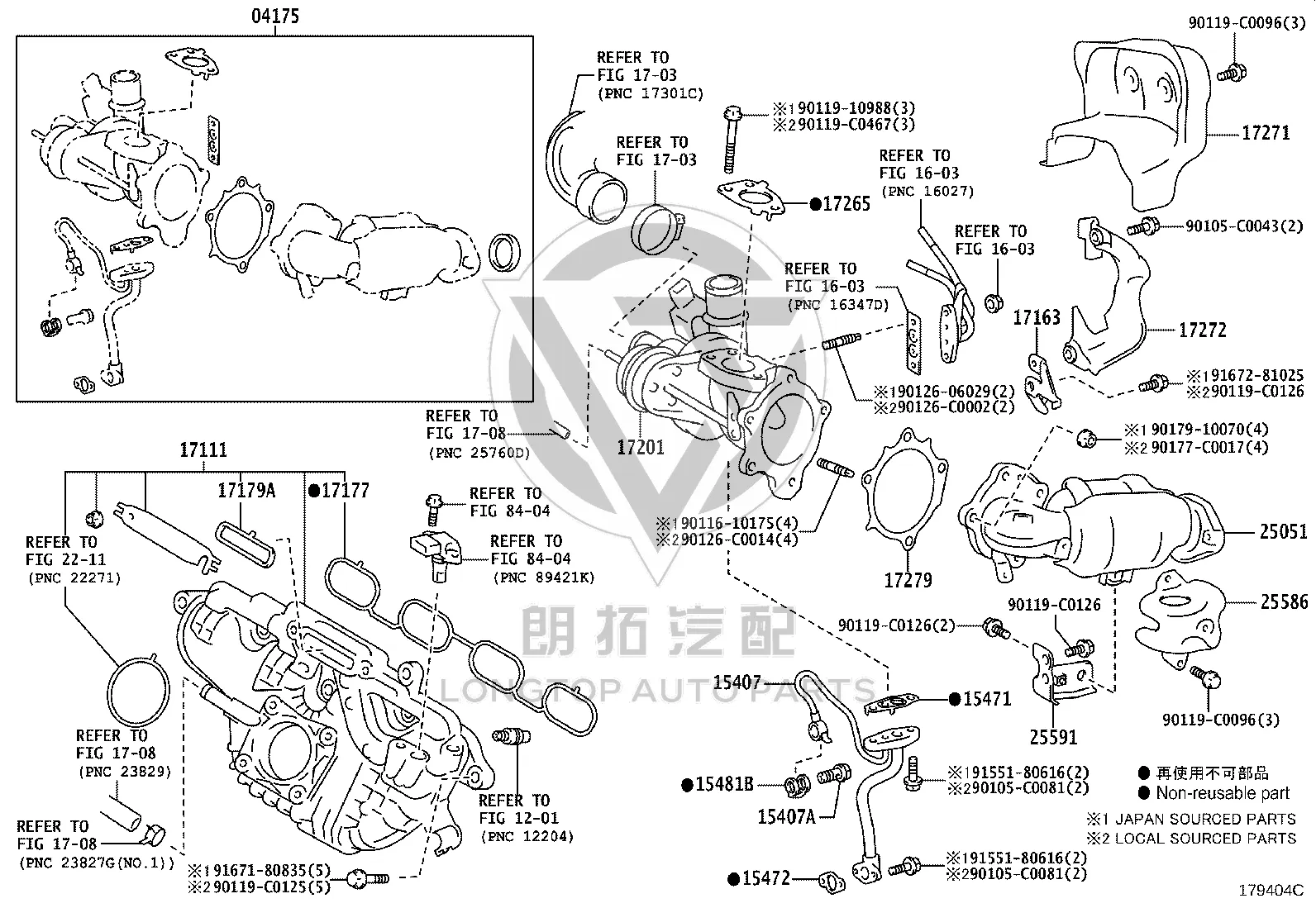
The GPF on a recent Corolla hybrid is mounted in the exhaust and replaced as an assembly, so the exact number follows the chassis code and build date. As a same-type reference for Corolla exhaust aftertreatment, the 25051-0Y120 three-way catalytic converter and the 17410-0T720 three-way catalytic converter are listed for the Corolla (China) E170 and E180 series from 2014 to 2019, an earlier exhaust layout than the 2023-and-later hybrid that carries the GPF, so they are shown as category references rather than direct fits. A buyer starts in the three-way catalytic converter category when a customer needs exhaust aftertreatment. The oil side matters too: the source recommends low-ash oil marked API SP or ACEA C5/C6, and buyers who supply these vehicles should confirm the oil spec before the customer’s next change, because a high-ash fill is what accelerates the next clog. Verify every number against the Toyota OE number guide before quoting.
What these cases teach parts buyers
- A GPF warning is almost always a driving-pattern fault, not a failed part, so the first fix is regeneration, not a replacement order.
- The exhaust aftertreatment number follows the chassis code and the emission spec, so a Corolla E180 catalytic converter is a reference for the family, not a direct fit for a 2023-and-later hybrid GPF.
- Low-ash oil is part of the repair conversation. A customer who keeps using high-ash oil will clog the next filter faster, and the oil spec is worth confirming with every parts quote.
- Exhaust parts sell in a tier: a filter clean is the cheap fix, regeneration is free, and a full assembly is the expensive end, so buyers should quote the whole range.
- Confirm the exact number with the genuine parts guide and the OE number check before committing, because exhaust aftertreatment is emissions coded and hard to return.
Need a catalytic converter, exhaust part, or GPF-related component for a Toyota or Lexus? Send the OE number and chassis code on WhatsApp or through the contact page, and we will confirm fitment before you order.

The LongTopAuto team writes from 25+ years of genuine Toyota and Lexus OEM parts export experience in Guangzhou, China. Our guides come from daily OE number checks, packaging review, and export sourcing work.