

Many overseas buyers lose money because they do not clearly define what they are buying before sending an inquiry: genuine Toyota, OEM, OE replacement, aftermarket, or simply a part that “looks the same.”
For importers, distributors, repair shops, and procurement teams, this difference affects price, customer trust, warranty handling, resale confidence, and long-term supply stability.
This guide explains why genuine Toyota parts matter, how they compare with OEM and aftermarket choices, and what buying framework overseas buyers should use before placing bulk orders.
Why do overseas buyers prefer genuine Toyota parts?
Overseas buyers prefer genuine Toyota parts when they need stronger trust, consistent quality expectations, and lower risk in resale or repair scenarios. Genuine parts are especially important when the buyer’s customer expects Toyota-branded supply rather than a substitute.
In many export markets, Toyota vehicles are used heavily in daily transport, commercial fleets, taxis, workshops, mining areas, construction sites, and government or company fleets. When a part fails early or does not fit correctly, the cost is not just the replacement part. It can also include labor, downtime, complaints, returns, and damage to the buyer’s reputation.
That is why many professional buyers choose genuine Toyota parts for:
- safety-related parts
- electronic components
- engine management parts
- suspension and steering parts
- high-value repair items
- customer-specified Toyota genuine orders
- parts that are hard to replace after installation
Genuine parts are not always the cheapest option. But for many overseas buyers, the value is in reducing uncertainty.
What does “genuine Toyota parts” actually mean?
Genuine Toyota parts refer to parts supplied under Toyota’s genuine parts system, usually with Toyota-branded packaging, Toyota part numbers, and packaging or label information that matches Toyota’s service parts supply standards.
This is different from simply saying “original quality” or “same as Toyota.” Those phrases are common in international parts trading, but they do not always mean the part is genuine Toyota boxed stock.
A genuine Toyota part should normally have several trust signals working together:
- Toyota part number or OE number
- Toyota-branded packaging where applicable
- consistent label information
- new and unused condition
- reliable supplier explanation
- clear invoice, packing, and shipment records
However, buyers should also understand one limitation: a box photo alone does not prove the full supply chain. Genuine Toyota parts purchasing still requires supplier reliability and part number confirmation.
Genuine vs OEM vs OE vs aftermarket: what should buyers know?
These terms are often mixed together, but they are not the same. A buyer who treats them as identical may compare the wrong prices or create problems for downstream customers.
| Term | Basic Meaning | Buyer Interpretation |
|---|---|---|
| Genuine Toyota Parts | Parts supplied under Toyota’s genuine parts system, usually Toyota branded and boxed | Best fit for buyers who need Toyota-branded confidence and resale trust |
| OE Parts | Parts made to original equipment specification or identified by original equipment number | OE number helps identify the part, but does not automatically prove Toyota genuine boxed supply |
| OEM Parts | Parts made by an original equipment manufacturer that may supply automakers | Can be good quality, but OEM does not always mean genuine Toyota packaging |
| Aftermarket Parts | Replacement parts made by third-party manufacturers | Price and quality vary widely; suitable for some markets but needs careful supplier selection |
| Repacked Parts | Parts placed into new or different packaging after the original supply process | Higher risk if the supplier cannot clearly explain source and condition |
The biggest misunderstanding is this:
OEM does not automatically mean genuine Toyota.
An OEM manufacturer may produce parts for automakers, but an OEM-branded part and a genuine Toyota boxed part are different sourcing categories. They may also carry different pricing, warranty expectations, and customer perception.
When should buyers choose genuine Toyota parts instead of OEM or aftermarket?
Buyers should choose genuine Toyota parts when the risk of failure, mismatch, customer complaint, or brand trust loss is higher than the savings from a cheaper alternative.
This does not mean every part must be genuine. In some markets, buyers may use OEM or aftermarket options for price-sensitive repairs. But genuine Toyota parts are usually safer for high-risk or high-expectation orders.
Genuine Toyota parts are often preferred for:
- sensors and electronic components
- airbag, brake, steering, and safety-related parts
- engine and transmission-related components
- parts requested by OE number from professional customers
- fleet maintenance where downtime is expensive
- luxury Toyota and Lexus repair scenarios
- orders where the buyer plans to resell as genuine Toyota
OEM or aftermarket parts may be acceptable when:
- the customer clearly accepts non-genuine supply
- the part is low-risk and easy to replace
- the market is highly price-sensitive
- the supplier can provide stable quality
- the buyer does not advertise the item as genuine Toyota
The key is transparency. A part should be sold according to what it actually is, not according to what sounds easier to sell.
What risks do overseas buyers face when sourcing Toyota parts?
The main risks are fake parts, refurbished parts sold as new, mislabeled parts, wrong OE numbers, and parts that do not match regional vehicle versions.
These risks are common because Toyota parts demand is high in many markets. High-demand items attract both reliable suppliers and unreliable sellers.
Common sourcing risks include:
- copied packaging
- real OE number printed on a non-genuine part
- used or refurbished item sold as new
- OEM part described as genuine Toyota
- aftermarket part packed to look more official
- wrong part supplied because of regional vehicle differences
- mixed-quality stock inside one bulk shipment
- supplier unable to explain product source
Regional differences also matter. The same Toyota model name may have different engines, production years, trim levels, steering positions, or market versions. This is why some parts require OE number or VIN confirmation before ordering.
Toyota also warns that counterfeit parts may carry fake Toyota trademarks and may not meet Toyota specifications, which is why overseas buyers should not rely on appearance alone. See Toyota’s official counterfeit parts warning.
What buying framework should importers use before sending an inquiry?
Importers should check five things before sending a serious inquiry: part identity, product category, authenticity signals, supplier reliability, and order risk.
This framework helps buyers avoid focusing only on price.
Toyota Genuine Parts Buying Framework
| Step | Buyer Question | Why It Matters |
|---|---|---|
| Part Identity | What exact part number or OE number do I need? | Prevents wrong-part orders before price comparison |
| Product Category | Is the request for genuine, OEM, OE replacement, or aftermarket? | Keeps buyer and supplier expectations aligned |
| Authenticity Signals | Are packaging, label, and condition consistent? | Helps reduce fake or repacked stock risk |
| Supplier Reliability | Can the supplier explain source, condition, and documentation? | Reduces risk beyond what photos can show |
| Order Control | Should I start with a trial order or request more verification? | Protects buyers before large-volume purchasing |
A professional buyer should not send only a general message such as “Please quote Toyota original parts.” A better inquiry includes:
- part number or OE number
- vehicle model or VIN when needed
- required product category
- quantity
- packaging expectation
- destination market
- whether genuine Toyota boxed parts are required
This reduces misunderstanding and filters out suppliers who cannot support accurate sourcing.
How should buyers start verifying genuine Toyota parts?
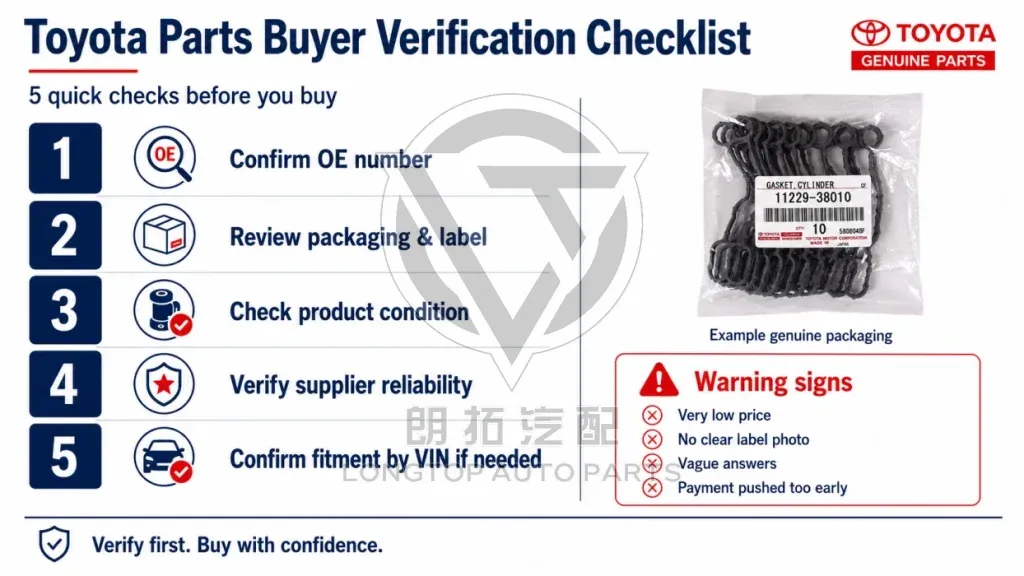
Buyers should begin with the part number and product category, then check packaging, label, photos, and supplier explanation. But detailed identification should be handled as a separate step-by-step process.
At the early stage, ask the supplier:
- Is this genuine Toyota boxed stock?
- Can you provide label and packaging photos?
- Is the part new and unused?
- Can you confirm by OE number?
- Is VIN confirmation needed for this item?
For a detailed operational checklist, buyers should use a separate identification guide focused on packaging, labels, OE numbers, photos, and supplier responses.
If you already understand why genuine Toyota parts matter and want a practical checking process, read our step-by-step guide on how to identify genuine Toyota parts before ordering.
Buyer caution: do not buy “genuine” based on wording alone
Many product descriptions use words that sound trustworthy but do not clearly define the part category. Buyers should be careful with vague phrases.
Be careful with descriptions such as:
- original quality
- same as original
- OEM quality
- Toyota type
- replacement original
- genuine quality
- factory standard
These phrases may describe quality claims, not the actual supply category.
Before paying for genuine Toyota parts, make sure the supplier clearly confirms whether the product is genuine Toyota, OEM, OE replacement, or aftermarket. This protects both the buyer and the buyer’s downstream customers.
FAQ
Are genuine Toyota parts the same as OEM parts?
No. Genuine Toyota parts are supplied through Toyota’s genuine parts system. OEM parts may come from manufacturers that supply automakers, but they are not automatically Toyota genuine boxed parts.
Are Toyota OE parts always genuine?
No. An OE number helps identify the correct part, but a real OE number can appear on different types of supply. Buyers still need packaging, condition, and supplier checks.
Are aftermarket Toyota parts bad?
Not always. Some aftermarket parts are acceptable for price-sensitive repairs, but quality varies widely. Buyers should not sell aftermarket parts as genuine Toyota.
Why are genuine Toyota parts more expensive?
They usually carry stronger brand trust, more consistent sourcing expectations, and higher resale confidence. The price also reflects the genuine supply category, not just the physical item.
When should I provide an OE number or VIN?
Provide an OE number whenever possible. Use VIN when the part may vary by engine, trim, production year, steering position, or regional vehicle version.

Auto parts insights from the Longtop team, focused on sourcing, quality, and practical product knowledge.