

A Camry that shifts harder after a transmission fluid change is not a failing gearbox. On this ticket a 2020 Camry at 68,000 km went into a chain workshop for what was billed as a standard service and came out with harsh D-range engagement and a downshift shudder in the 30 to 50 km/h band that was 47 percent more frequent than before. The scanner told the story: the torque-converter lock-up clutch engagement time stretched from 0.8 seconds to 1.3 seconds, and line-pressure fluctuation swung from ±5 kPa to ±15 kPa. The cause was not the transmission. It was the fluid change itself, with 23 percent of the old oil left behind.
For a parts buyer this case is a reminder that the fluid, the filter and the pan gasket are a matched set, and none of them can be skipped or substituted. The figures below are kept as recorded, because the AA81E eight-speed behind the 2.5 and 3.5 litre petrol Camry is a tight-tolerance gearbox that answers a wrong oil or a half-done drain with shift faults that a scanner can measure.
Case 1 – Camry AA81E eight-speed, harsh shifts after a fluid change
Symptom. After a standard fluid service the car came back with harsh D-range engagement and a downshift shudder between 30 and 50 km/h. The shift complaint measured 47 percent more frequent than before the service. The scanner recorded a torque-converter lock-up clutch engagement time that had stretched from 0.8 seconds to 1.3 seconds, and line-pressure fluctuation that had widened from ±5 kPa to ±15 kPa.
Diagnosis. The AA81E box holds a theoretical 8.1 litres, but the first drain only removed 7.2, leaving nearly a litre of old oil mixed into the new fill, which dropped the viscosity index by 18 percent. The oil drained at that service went to a laboratory, and the results explain why Toyota specifies WS fluid. Kinematic viscosity at 100°C measured 5.8 mm²/s against a WS requirement of 6.8 to 7.8 mm²/s. Shear stability came in at 22 percent against a 15 percent maximum, and the PAO content was only 38 percent where the genuine fluid carries 62 percent. PAO is what holds the oil-film strength, and with nearly half of it missing the film strength fell by 31 percent, enough for micro-pitting on the gear teeth at 3000 rpm. The drum used at that workshop was labelled WS-compatible, but compatible is not the same as meeting the specification. The genuine WS oil carries ester-based additives that build a protective film on the metal surfaces, while the aftermarket oil used a silicone anti-foam agent that breaks down into 2 to 5 micrometre silica particles at 120°C, exactly the size that clogs the valve-body galleries; three months on, valve-body solenoid response was delayed by 0.2 seconds. The gap is on paper too: the JASO M356 anti-foam limit is 150 ml/10 min while generic oils exceed 300, and the Dexron VI shear-stability ceiling of 12 percent is missed by most non-certified oils by a wide margin.
Fix. The car was re-serviced at a Toyota-certified workshop with a PROTEX PX-05 exchange machine. The machine runs a three-stage filtration, an 80-micrometre primary screen for metal debris, a 5-micrometre secondary element for fibres and a 1-micrometre final screen for sludge, all at a steady 1.2 bar so the new oil reaches every corner of the planetary gear set. After the re-fill the lock-up engagement time came back to 0.7 seconds and line-pressure fluctuation settled to within ±2 kPa. The second service drained 7.2 litres, confirming the first one had left about a litre behind, so the box was never faulty and the first service was simply not finished. The same workshop’s own records show how often the corners get cut: 32 percent of technicians reused a non-genuine pan gasket instead of the specified T-II type, and 17 percent skipped removing the pan to clean the magnet, the magnet that collects the 0.1 to 0.5 mm steel particles that would otherwise reach the valve body and jam a solenoid. Poor pan cleaning alone accounted for 19 percent of the transmission failures in that shop’s 2024 data, at an average repair cost of 23,000 RMB. Fill level is a precision job as well: the AA81E has a 7.8 to 8.0 litre window where it shifts cleanest, churning resistance rises 12 percent above 8.2 litres, and below 7.5 litres the risk of the oil pump drawing air climbs sharply.
Parts notes. The buy list that maps to this repair is short. The fluid is Toyota Automatic Transmission Fluid WS, carried under OE number 08886-80200. The filter and the pan gasket are changed with it, because the filter and gasket are exactly what a half-done service skips. On the eighth-generation Camry the transmission filter 35330-48040 and the pan gasket 35168-73010 are both listed for the ASV70, GSV70 and AXVA70 chassis, which covers the 2017 to 2023 cars including this 2020 example. Confirm the chassis before ordering, since these numbers do not carry over to the earlier six-speed cars.
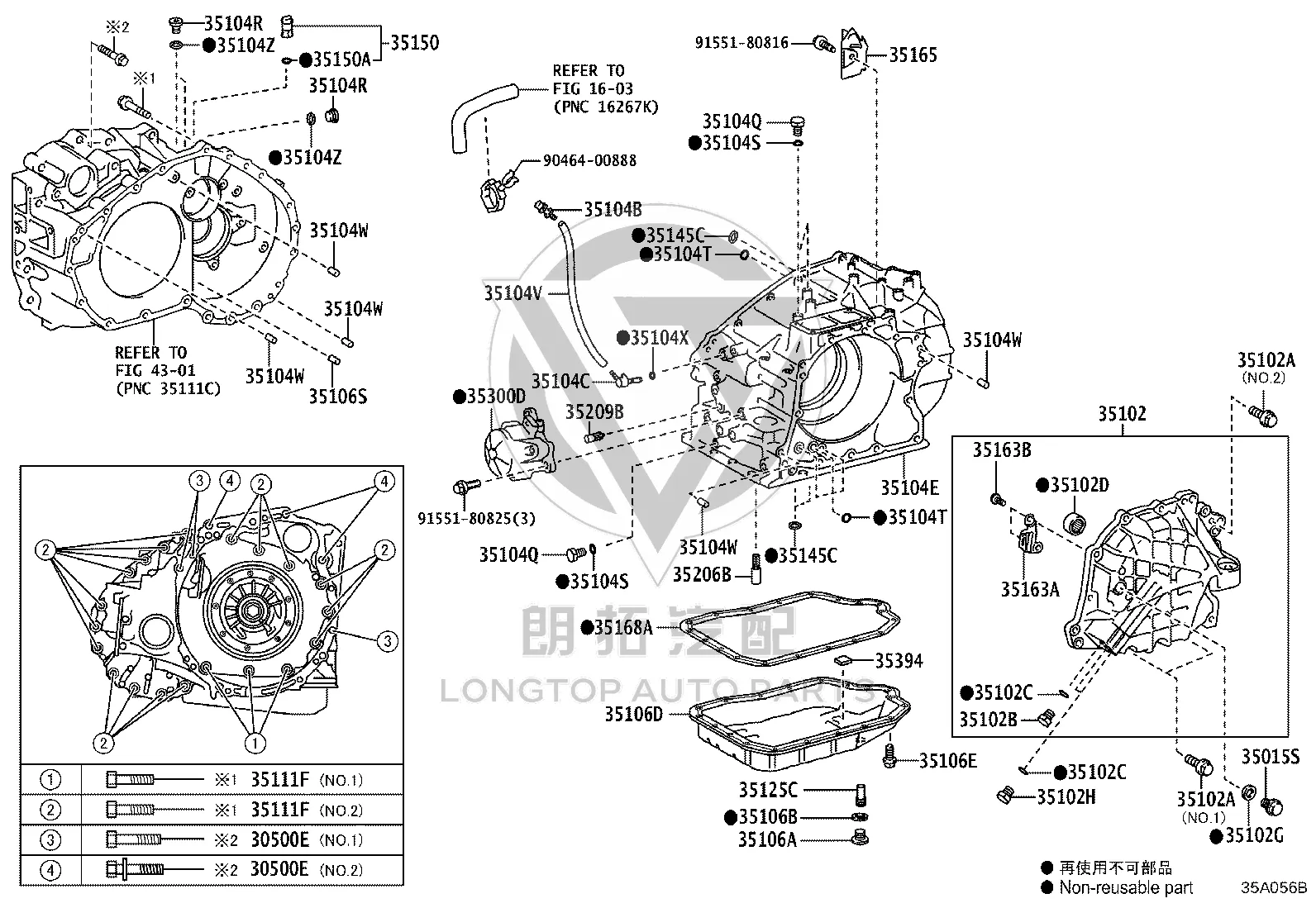
The parts shelf around this job is what keeps a transmission account alive. The fluid, the filter and the gasket move together at every pan-off service, and the workshops that skip one of them are the ones whose cars come back with the shift complaint the scanner reads as a stretched lock-up time.
What this case teaches parts buyers
- The fluid is specified, not generic. WS is a specification with a 6.8 to 7.8 mm²/s viscosity and a shear-stability ceiling, and a drum labelled WS-compatible does not meet it. Sell the genuine ATF WS fluid.
- The filter and gasket are part of the service. A fluid change that leaves the old filter and reuses a generic gasket is a half job, and the source data shows 32 percent of non-genuine gaskets skipped the specified T-II type. Stock the transmission filter and the pan gasket together.
- Fill level is a tolerance. The AA81E shifts best inside the 7.8 to 8.0 litre window, so the buyer who also stocks the measuring gear sells the complete service, not just the drum of oil.
- Chassis decides the number. The AA81E filter and gasket belong to the ASV70, GSV70 and AXVA70 eighth-generation Camry, not the earlier cars, so run the OE number check before committing.
- The magnet and the gasket are the repeat business. Pan-off services are where the filter, gasket and fluid all move together, which is why sourcing genuine parts and knowing how to tell genuine fluid from a copy keeps that account coming back.
If you supply Toyota and Lexus automatic transmissions or need the WS fluid, filter and pan gasket for the Camry eight-speed, send the OE numbers or chassis codes on WhatsApp or through our contact page. LongTopAuto matches genuine Toyota and Lexus parts by OE number, with fitment confirmed against chassis code and production year.

The LongTopAuto team writes from 25+ years of genuine Toyota and Lexus OEM parts export experience in Guangzhou, China. Our guides come from daily OE number checks, packaging review, and export sourcing work.