

A RAV4 that creaks over speed bumps and wears the inner edges of its rear tyres is rarely a worn-out suspension. The four faults below are the ones this model actually throws up in service, and in most of them the fix is a cheap part or a service habit rather than a new axle or a shock absorber.
For a parts buyer, the useful signal is what does not need replacing. Three of these four faults are routinely quoted as a whole-assembly swap, and the documented repair for each is a small part or a procedure. The specifics below are kept as recorded, because the gap between the quote and the real fix is exactly where a buyer saves money and a seller earns trust.
Case 1 – Suspension creak over speed bumps (bushing and strut mount, not a shock)
Symptom. Past roughly 60,000 km the car starts to creak over speed bumps, a dry crackling sound that drivers describe as unsettling. It is loudest at low speed on broken pavement and on cold mornings.
Diagnosis. A dealer will commonly recommend replacing the whole shock absorber, quoted at more than ¥1,200 per side. The recorded experience is that around nine out of ten of these creaks come from aged rubber, either the stabilizer bar bushings or the strut top mount, and only a minority from a genuinely failed shock. In one documented case the workshop pulled the strut apart and found only a cracked top mount, and replacing it for about ¥180 stopped the noise the same day.
Fix. Replace the worn rubber, not the strut. A stabilizer bar bushing or a top mount costs a fraction of a shock absorber and is a straightforward bolt-in job. Only when the shock itself is leaking or the damping is visibly gone does the strut core need to come out.
Parts notes. For the RAV4 the rubber parts around the suspension are the stock items that match this fault:
- Front stabilizer bar bushing 48815-42090 (left) and rear stabilizer bar bushing 48818-42010 (left), listed for the RAV4 ACA3# chassis (2005-2012)
- Front shock absorber core 48520-8Z003, for the later RAV4 ASA4#/ZSA4# generation (2013-2019), when the strut itself is confirmed worn
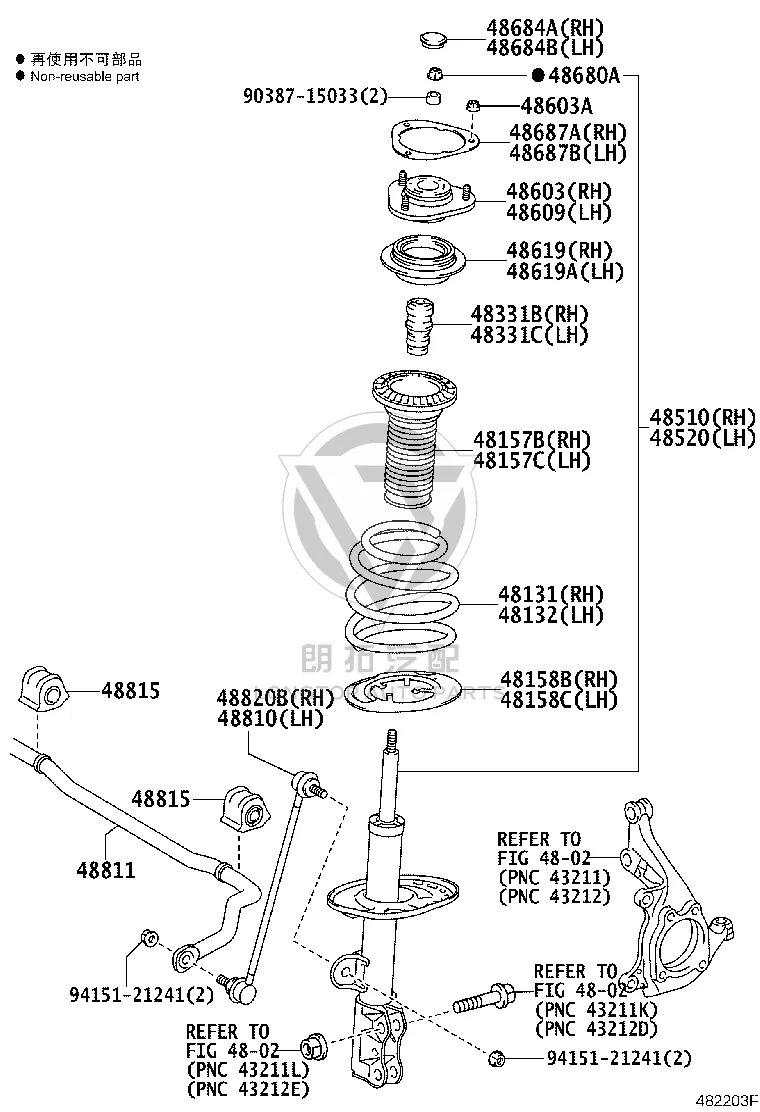
The sequence is worth carrying over, because it is cheap to confirm and expensive to guess wrong. A creak that comes from rubber returns within months if you only fit a new strut, while a bushing checked at service time is a few yuan of prevention against a four-figure bill.
Case 2 – Rear tyre inner-edge wear (alignment and pressure, not an axle)
Symptom. The rear tyres wear down to bald on the inner shoulder while the outer tread still looks serviceable. Owners usually notice it at rotation time or when the worn edge begins to hum at speed.
Diagnosis. The RAV4 rear suspension is set up slightly toward the sporty side, so the alignment angles drift with use, and low tyre pressure or frequent heavy loads push the inner edge to take the load. A quote in one recorded case reached ¥2,800 for a suspension assembly, but the actual cause was alignment and pressure, not a bent or worn axle.
Fix. A four-wheel alignment, a reset to 2.4 bar, and tyre rotation every 10,000 km. In the documented case the wear pattern settled back to even within three months and no suspension component was touched.
Parts notes. This one is a procedure rather than a parts sale, which is itself the lesson. If the inner edge is bald but the geometry is correctable, the buy list is an alignment and a tyre, not a control arm. The discipline before ordering is the same as for any part: confirm the chassis code and run the OE number check before committing to a component.
Case 3 – Hybrid oil cap “milkshake” in cold weather (condensation, not a head gasket)
Symptom. On the hybrid RAV4 in northern winters, or with mostly short trips, a whitish foam appears on the underside of the oil filler cap. Owners read it as coolant in the oil and brace for a head-gasket quote.
Diagnosis. Toyota’s own technical guidance describes this as a physical effect, not an engine fault. In cold weather with short runs the combustion moisture never gets hot enough to evaporate, and it condenses into an emulsion at the cap. The engine itself is sound.
Fix. Run the engine fully warm for about 20 minutes at highway speed once a week and use the specified 0W-16 oil. In the documented case the foam cleared on its own within three weeks, while a neighbour who paid for a deep engine clean had the same symptom come back.
Parts notes. The only parts angle here is the oil itself: stick to the specified 0W-16 grade. There is no gasket, no cooler and no rebuild in the correct fix, and buying one would not move the symptom. For the consumables a hybrid depends on, identifying genuine Toyota parts matters more than the repair.
Case 4 – Interior creaks and a laggy head unit
Symptom. The cabin develops small creaks from the hard plastic trim on rough roads and in cold weather, and the infotainment screen turns sluggish or the reversing camera drops to a blur.
Diagnosis. The trim is hard plastic by design, and the joins rub as the panels expand and contract with temperature. The head unit is a budget-resolution unit, and its lag is the hardware, not a fault that a strip-down will find.
Fix. Self-adhesive flocked tape pressed into the trim gaps kills the creak for a few yuan, and a periodic restart of the head unit with background apps closed restores the response. Neither needs a new panel or a new screen.
Parts notes. These are finish-and-experience items with no OE replacement in the correct fix. The wider point is that a supplier who sells genuine parts on trust does better directing a customer to the two-yuan tape than to a trim panel costing far more that would not cure the noise.
What these cases teach parts buyers
- Creaks are usually rubber. Before quoting a shock, check the stabilizer bar bushings and strut top mount; they are the cheap, common cause.
- Tyre wear is geometry first. Inner-edge wear points to alignment and pressure before it points to an axle or a control arm.
- White foam on a hybrid cap is condensation. Cold short trips cause it, and the fix is heat and the right oil, not a rebuild.
- Match the chassis, not just the name. RAV4 suspension parts differ between the ACA3# and ASA4#/ZSA4# generations, so confirm the chassis code and check the OE number before ordering.
- Trust is the asset. Selling the two-yuan bushing instead of the four-figure strut is how a parts supplier keeps a workshop’s business, and the genuine parts guide covers the verification side.
If you stock RAV4 suspension, steering or service parts for your market, send the OE numbers or chassis codes on WhatsApp or through our contact page. LongTopAuto matches genuine Toyota and Lexus parts by OE number, with fitment confirmed against chassis code and production year.

The LongTopAuto team writes from 25+ years of genuine Toyota and Lexus OEM parts export experience in Guangzhou, China. Our guides come from daily OE number checks, packaging review, and export sourcing work.