

Four Toyota repair tickets where the component that fixed the car was not the one the symptom pointed to. The fault codes, engine speeds, and mileage figures below are kept as the workshop recorded them, because for a parts buyer the useful signal sits in those numbers rather than in the symptom label.
The four cars span the Mark X, Corolla, RAV4, and Yaris platforms. Three of the four were closed with a replacement part; one was closed by re-routing a pair of brake pipes.
Case 1 — Mark X no-start traced to a collapsed muffler (2012, 130,000 km)
Symptom. A 2012 Mark X on the GRX platform with 130,000 km came in as a no-start. The owner could not get the engine to run.
Diagnosis. The shop cleared the immobilizer first, because the security indicator went out normally once the key was in the ignition. The engine control unit held no fault codes, and a spark test passed. The spark plugs told the real story: the electrodes were soaked in fuel. After the plugs were cleaned and the fuel drained from the cylinders, the engine started, then died moments later as if starved, with the plugs wet again. The shop repeated this several times and got the same result every time. During these attempts the idle climbed to 3000 rpm before the engine cut out. With the throttle held open, the tailpipe flow was weak. Removing the exhaust revealed a muffler that had corroded and collapsed inside, where loose sound-deadening material had soaked up water in the pipe and frozen, blocking the exhaust.
Fix. The exhaust pipe assembly was replaced, and the fault cleared.
Parts notes. Our catalog does not list a Mark X muffler assembly, but the failure pattern is what a buyer quotes against. Wet plugs plus strong spark plus weak exhaust points to back pressure before it points to the ignition or the fuel pump. On a salted-road car this platform’s exhaust is a wear item, and the genuine parts identification guide covers how to spot a correct replacement versus a lookalike.
Case 2 — Corolla no-start after a starter swap, closed by the ECM (2006, 170,000 km)
Symptom. A 2006 Corolla with 170,000 km would not start after the starter motor had been replaced.
Diagnosis. With the key in, the security indicator blinked, which is backwards: a healthy car blinks it only after locking, not with the key in. The instrument cluster showed no engine warning lamp. The engine control unit would not communicate, and the vehicle information could not be read. Power and ground at the control unit both measured normal, which put the fault inside the unit itself. The shop suspected the battery terminals had been reversed when the battery was disconnected during the starter job.
Fix. A replacement engine control unit ended the no-start.
Parts notes. For this platform the unit is the engine computer 89660-02E60, listed for the Corolla built in China from 2004 through 2017, which covers this 2006 car. See also the engine computer category.
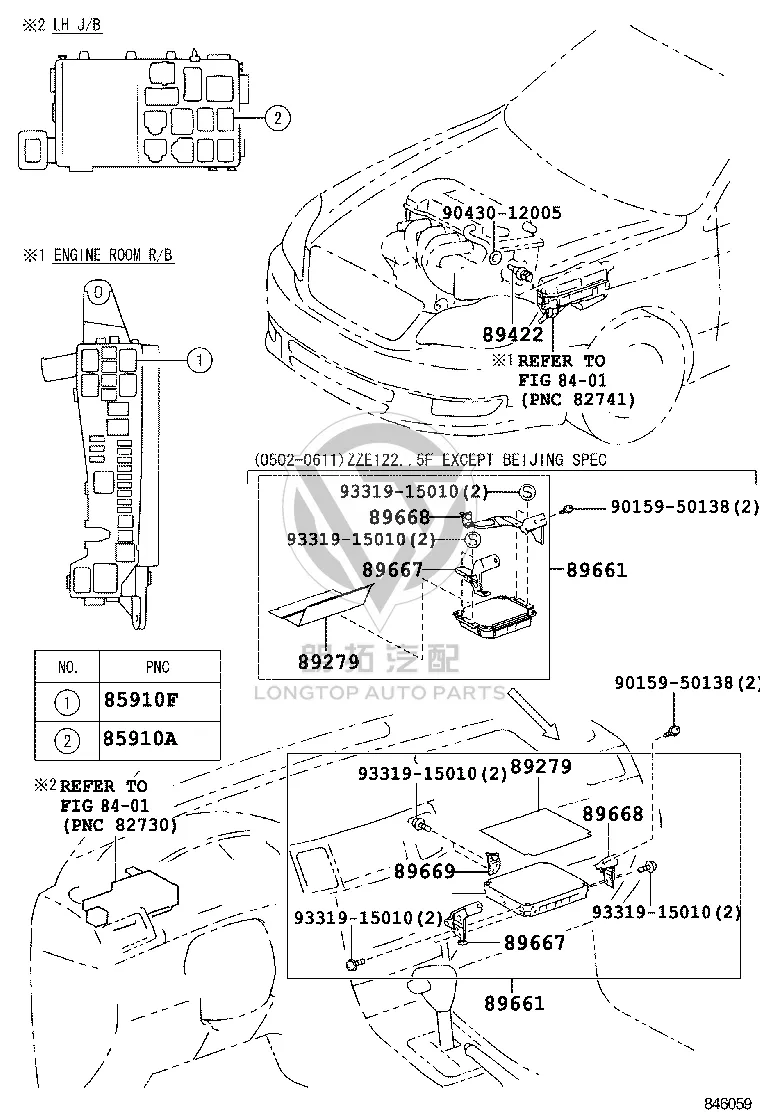
A starter swap is a common place for a battery to go back reversed, which is what takes out the control unit.
Case 3 — RAV4 brake pull traced to crossed brake pipes (2006, 190,000 km)
Symptom. A 2006 RAV4 (ACA37L, 1AZ engine) with 190,000 km pulled to the right under hard braking.
Diagnosis. During a hard stop the ABS was active, but only the right front tire left a mark, which is exactly why the car pulled right. Pads, discs, calipers, and lines all inspected fine. A diagnostic recorder captured the event: on the right rear, the inlet solenoid cut master-cylinder pressure to the wheel cylinder while the outlet solenoid opened the return path, so the right rear brake released completely. Wheel-speed data showed only the right front was likely to slip, which raised the question of why the ABS was adjusting the right rear at all. Removing the air filter housing exposed the ABS valve body, where the brake pipes were routed oddly. Checking against the repair manual confirmed the right front and right rear pipes, which sit side by side, had been swapped into each other’s positions. The ABS adjustment meant for the right rear was being applied to the right front.
Fix. The pipes went back to their correct positions, and the pull disappeared.
Parts notes. This was an assembly error, not a failed part, so nothing was replaced. When a brake pipe does need replacing, the tube for the right rear is the brake hard line 47321-0R020, listed for the RAV4 (ACA3 series) built from March 2009 through July 2013. Note the fitment window: this is a later RAV4 than the 2006 car in the case, so quote it against the chassis code rather than the year. See the brake hose and pipe category.
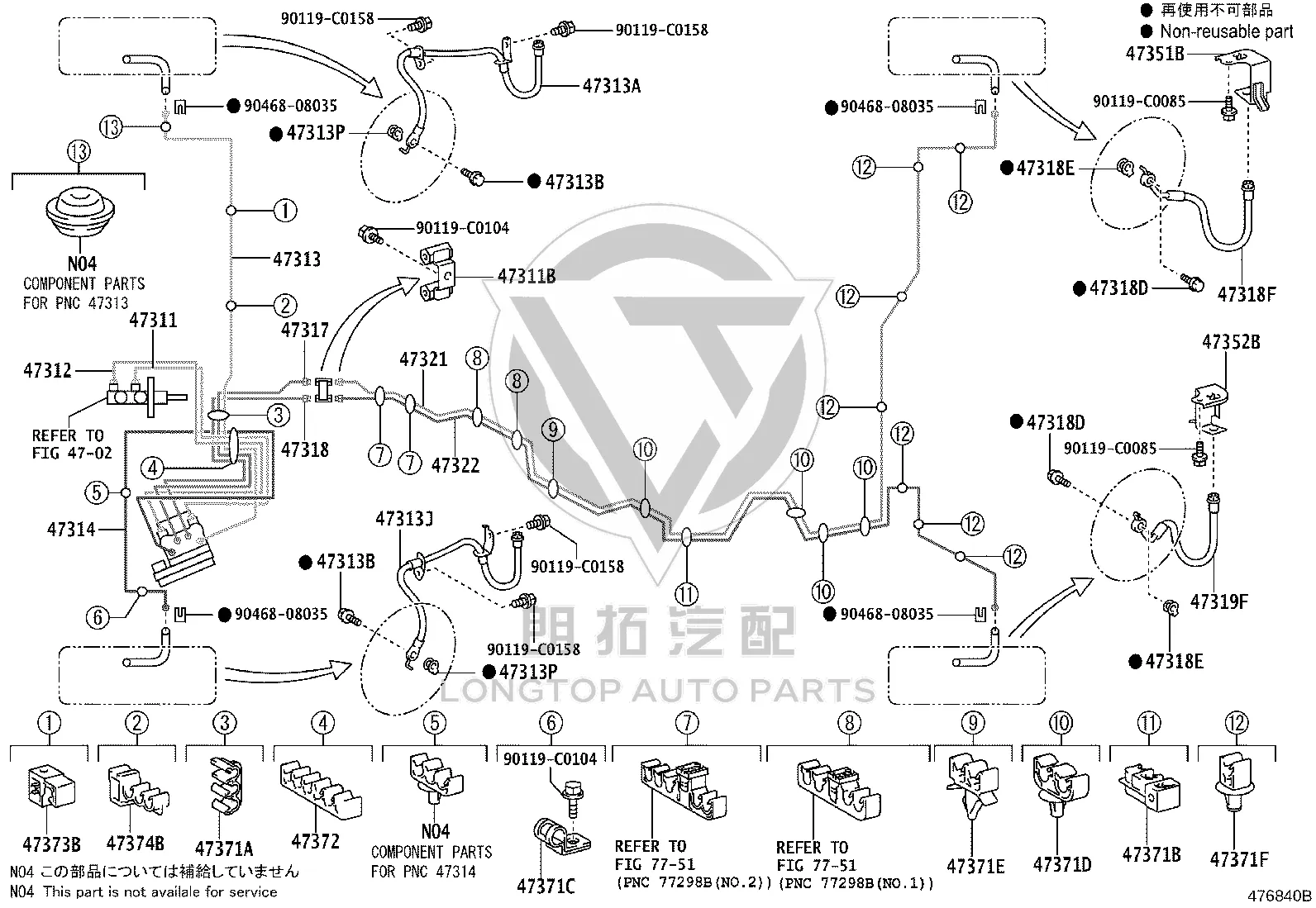
Crossed brake pipes are an assembly error, not a parts failure, and the fix is a re-route rather than an order.
Case 4 — Yaris rising revs from a failed torque converter lock-up (2011, 150,000 km)
Symptom. A 2011 Yaris (ZSP91L, 1ZR engine) with 150,000 km came in because the revs ran higher than before and fuel use kept climbing.
Diagnosis. The powertrain control unit held P2757, a torque converter clutch pressure control solenoid performance fault. The freeze-frame data showed that with the lock-up clutch engaged, the transmission input speed and engine speed still differed, so the converter was trying to lock but not fully doing so. An active test through the Toyota diagnostic tester cycled the lock-up clutch open and closed; the engine speed response and the drive feel both behaved, so the control side was sound and the fault sat in the lock-up clutch itself.
Fix. The torque converter assembly was replaced, and the revs and fuel use returned to normal.
Parts notes. We do not list a Yaris torque converter, so this one is a diagnosis lesson rather than a quote. Before condemning a converter on P2757, run the active lock-up test: if the clutch obeys the command, the solenoid and its control circuit are fine and the mechanical clutch is the suspect. The same OE-number discipline applies, covered in the Toyota OE number check.
What these cases teach parts buyers
- Follow the measurement, not the symptom. The no-start pointed at ignition and fuel but the numbers said exhaust; the brake pull pointed at the brakes but the recorder pointed at the pipes.
- Chassis code decides the order. The RAV4 brake tube fits a specific production window, and the Corolla ECM covers a specific build range. Model name alone is not enough.
- Assembly mistakes damage parts. A reversed battery during a starter swap killed the ECM, and swapped pipes fooled the ABS.
- Verify before you condemn. The lock-up clutch was only cleared after the active test ruled out the control side. The same habit applies when you order: how to identify genuine Toyota parts and the OE number verification workflow.
If you need any of these components, or the wider engine, brake, and driveline ranges for your market, send the OE numbers or chassis codes on WhatsApp or through our contact page. LongTopAuto matches genuine Toyota and Lexus parts by OE number, with fitment confirmed against chassis code and production year.

The LongTopAuto team writes from 25+ years of genuine Toyota and Lexus OEM parts export experience in Guangzhou, China. Our guides come from daily OE number checks, packaging review, and export sourcing work.