

Toyota Frontlander Brake Pedal Sinking: Diagnosing the Master Cylinder and Booster
A Toyota Frontlander owner noticed a strange brake pedal feel about six months into ownership, around a year after the car was delivered. Pressing the pedal dropped it two to three centimetres with no braking force, and then the pedal suddenly sank a large extra distance before the brakes finally bit. The owner described the sensation as a loose tooth, an empty first stage followed by an abrupt dive.
The dealer inspected the car and returned a verdict of “normal,” insisting every Toyota feels this way and that nothing could be repaired. Independent mechanics the owner asked saw it differently. They suspected the brake master cylinder or the brake booster, and that is where the diagnostic value of this case lies.
The case: brake pedal free travel on a Toyota Frontlander
Symptom
The fault showed up at the pedal. The owner pressed the brake and felt the first two to three centimetres travel with no resistance and no effort, then the pedal was pulled down a large extra distance in a single drop before the car actually braked. The empty stage appeared sometimes at the very start of the press and sometimes partway through, so there was no fixed point where the pedal let go. The unpredictability was the worst part, the owner said, because the fear was always that the dead stage would arrive just before the pedal reached the bottom.
Diagnosis
The dealer checked the car and told the owner the behaviour was normal for a Toyota and could not be repaired. The owner disagreed and asked independent mechanics, who pointed to two likely culprits: the brake master cylinder and the brake booster.
Some background sorts the two explanations apart. Every brake pedal carries a small amount of free travel by design, a short light stage before the pushrod engages, and that buffer is normal. What this owner felt was different: a sudden large drop in the middle of the stroke, which is not free travel. In hydraulic terms, air trapped in the brake lines, or a small fluid leak somewhere in the circuit, produces exactly this behaviour, a pedal that turns soft and sinks partway through the press. A master cylinder that leaks internally, or a booster that loses vacuum assist, does the same thing.
The owner also noted that other Frontlander drivers reported nothing like this. Some said the Toyota pedal felt slightly softer than other brands, but none described the pedal dropping away mid-stroke the way this one did. That is the detail that separates a normal characteristic from a fault.
Others suggested the owner was simply adapting from a different brand and that every car’s pedal is tuned differently, so the brake needed time to get used to. The owner did not accept that explanation either, because the dead stage and the sudden drop had persisted this long and left too much uncertainty.
Fix
The dealer did not repair the car and stood by the “normal” verdict, so there is no resolved repair to report. What the diagnosis leaves behind is a clear checklist. A shop that sees this symptom should start at the fluid circuit: bleed the brakes to clear any air, and inspect every line, fitting and the master cylinder for a leak. Then check the master cylinder itself for internal leakage, which lets fluid bypass the piston and makes the pedal sink under steady pressure. If the fluid side is clean, the booster is the next suspect, because a booster that loses vacuum removes the assist and changes the pedal feel. The point of the case is not that one part was replaced; it is that the dealer’s “normal” answer skipped all of these checks.
Parts notes
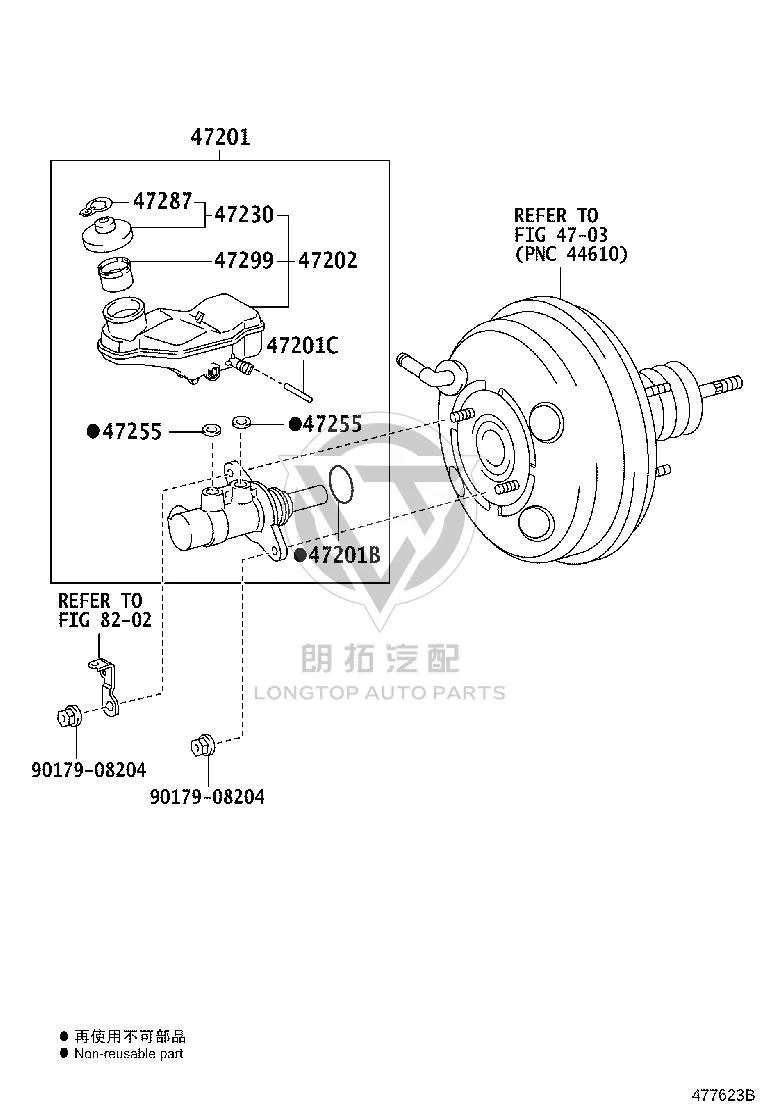
The Frontlander is the China-market Corolla Cross, and its brake hardware is chassis specific, so the exact master cylinder and booster number has to be confirmed against the vehicle code before ordering. As a same-type reference, the 47201-02820 brake master cylinder is listed for the Corolla (China) E170 and E180 series, the Levin hybrid and the E’Z rather than the Corolla Cross, so it is shown here as a category reference, not a direct fit. The 47070-12020 brake booster pump carries a Corolla listing as well. Both sit in the brake master cylinder and brake booster pump categories, which is where a buyer starts when a customer reports a sinking or empty brake pedal. Verify every number against the Toyota OE number guide before quoting, because brake fitment follows the chassis code, not the model name.
What these cases teach parts buyers
- A brake pedal that sinks mid-stroke is a hydraulic symptom, not a normal characteristic. Free travel is short and light; a sudden drop is a fault.
- Air in the lines, a fluid leak, a leaking master cylinder and a weak booster all produce the same pedal feel, so the checklist starts at the fluid and works toward the booster.
- The Frontlander shares its brake architecture with the Corolla family, but fitment still follows the chassis code, so a same-type reference must be flagged as such.
- Customers who report this symptom are asking about brake hydraulics, not brake pads, and the master cylinder and booster are the parts to keep ready.
- Confirm the exact number with the genuine parts identification guide and the OE number check before quoting, because a brake part ordered off the wrong chassis code will not fit.
Need a brake master cylinder or booster for a Toyota or Lexus? Send the OE number and chassis code on WhatsApp or through the contact page, and we will confirm fitment before you order.

The LongTopAuto team writes from 25+ years of genuine Toyota and Lexus OEM parts export experience in Guangzhou, China. Our guides come from daily OE number checks, packaging review, and export sourcing work.