

The dashboard is one of the quieter reliability complaints on a Toyota Corolla. The car has sold more than fifty million units worldwide and earned its reputation on mechanical dependability, but on a large share of them the padded instrument panel surface eventually develops fine hairline cracks. On older cars these open into long splits, and the surface takes on an oily, glossy sheen that throws glare back into the driver’s line of sight. The same aging shows up around the panel as trim that turns brittle and buttons that stop responding.
For a parts buyer the useful item on this ticket is the instrument panel assembly, because it is the one part that turns a cosmetic complaint into a sellable component. The cracking is not something every dashboard eventually does. It traces back to three specific causes, material, environment and use, and the repair is graded by how far the surface has gone. The figures below are kept as recorded in the source, including the complaint data that places the 2007 to 2011 build years at the top of the list.
Case 1 – Corolla dashboard, from hairline marks to full splits
Symptom. The first sign is a network of fine cracks across the top of the instrument panel. On older cars, most often the 2007 to 2011 examples, the cracks widen into large splits and the surface takes on a reflective, oily finish that catches sunlight and sits in the driver’s view. Complaint data shows the issue is not limited to the old cars, since owners of 2021 and 2024 models have logged the same reports. Around the panel, the plastic trim hardens and turns brittle, and the switches and buttons lose their click and feel.
Diagnosis. The failure comes from three causes. The first, and the one the source calls the root of the problem, is a material and process defect in the original trim. Owners and repairers report that recycled material was blended into the plastic polymer used for the dashboard, which leaves the soft foam layer prone to fracture, and this has been carried across several model years rather than fixed. The second cause is environmental. Long sun exposure lets ultraviolet light break down the molecular structure of the surface until it turns brittle, and the records put this exposure factor at about thirty percent of cracking cases. Repeated hot and cold cycles add their own damage as the material expands and contracts until stress cracks form. The third cause is how the car is used. Heavy objects left on the panel, perfume bottles and ornaments in particular, press a constant load into one spot until it sinks and splits. Cleaning with an alcohol-based or disinfecting solution swells the PMMA surface and opens stress cracks, and wiping with a dry paper tissue leaves fine scratches that only get worse.
Fix. Treatment is graded by severity, and warranty comes first. On the high-risk 2007 to 2011 cars the first step is to check the complaint records, since a number of dealers will replace or refinish the panel free of charge once the complaint is raised. A newer car still inside warranty gets a free repair when the cracking is confirmed as a material defect. For light cracks, a repair compound is filled into the marks, then sanded and polished back to a smooth surface, at roughly 300 to 800 RMB. For larger cracks the panel is plastic-welded, then sanded and repainted, at about 500 to 2000 RMB. When the cracking is extensive or the material is clearly aged, the panel is swapped for a complete instrument panel assembly, at 1000 to 4000 RMB depending on the grade of the replacement material. The source stresses choosing a competent workshop, because a repair done with substandard material ages faster than the original fault.
Parts notes. The replaceable item for a buyer is the instrument panel assembly itself. On the current-generation Corolla the panel shell is carried under OE number 55400-02520C1, listed for the E210 chassis built from 2018 onward. Note the fitment line: this number maps to the current car, while the 2007 to 2011 cars that dominate the complaint data are an earlier chassis, so the chassis code has to be confirmed before ordering. The trim panels and switch housings that surround the dashboard sit in the same instrument panel housing range, and they are bought by the same shops that take on the refinish work.
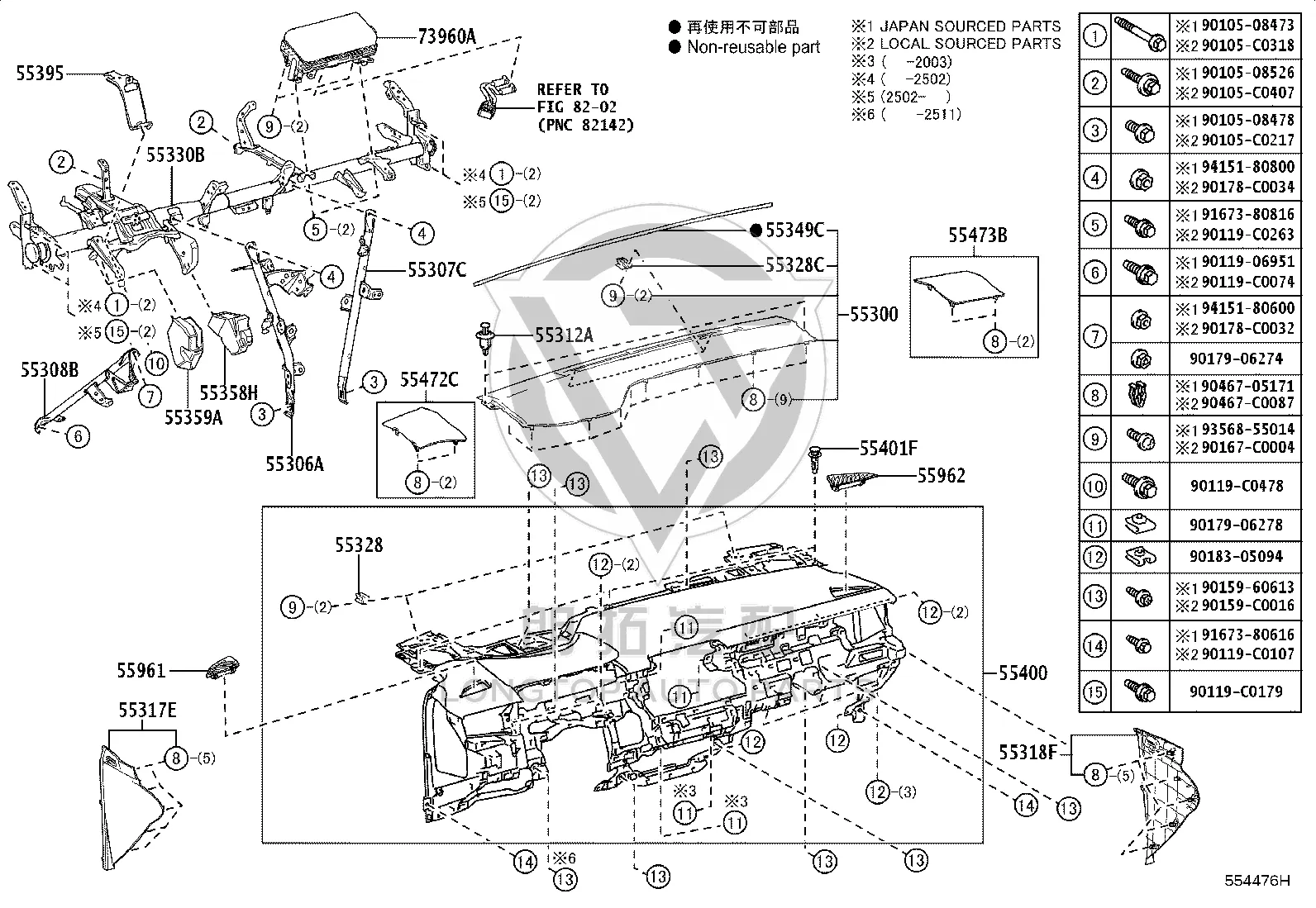
The point that matters to a buyer is where the money goes. On the old cars the free-replacement route runs through the complaint records, so the dealer and the owner settle before any part is ordered. On the current cars, where the panel is bought outright, the assembly is the part that carries the margin, and the trim pieces around it are the add-on.
What these cases teach parts buyers
- The panel, not the car, is the part. Dashboard cracking is a material fault on the instrument panel assembly, and the assembly is what a workshop orders once the cracking has passed the point of repair.
- Know which chassis the number fits. 55400-02520C1 covers the E210 Corolla from 2018 onward, not the 2007 to 2011 cars, so confirm the chassis code instead of going by model year alone and run the OE number check first.
- Cracking is graded before it is bought. Light cracks are filled and polished, so the assembly is only ordered for the extensive cases, which means the small repair compounds and touch-up materials move before the panel does.
- Environment is the repeat-sale driver. UV and heat sit behind about a third of the failures, so the protection films and surface dressings sold alongside the panel are the recurring line on the shelf.
- Genuine material is the trust point. A substandard replacement ages faster than the original, which is why sourcing genuine Toyota parts matters for this job and how to tell a genuine panel from a copy.
If you stock Corolla interior parts or need the instrument panel and surrounding trim for your market, send the OE numbers or chassis codes on WhatsApp or through our contact page. LongTopAuto matches genuine Toyota and Lexus parts by OE number, with fitment confirmed against chassis code and production year.
Browse genuine TOYOTA COROLLA OEM parts
3,393 OE numbers with VIN-verified fitment, wholesale export pricing.
View TOYOTA COROLLA Parts Catalog
The LongTopAuto team writes from 25+ years of genuine Toyota and Lexus OEM parts export experience in Guangzhou, China. Our guides come from daily OE number checks, packaging review, and export sourcing work.