

I’m Mason, a 12-year International Auto Parts Market and Sourcing Strategy Manager specializing in Toyota and Lexus parts. In real sourcing work, I rarely start by asking only “which supplier is cheaper?” A better question is: which Toyota parts are worth stocking in your market, which parts should be ordered only after confirmation, and which sourcing channel can support your margin without creating wrong-part or overstock risk?
This Toyota parts sourcing guide helps you build a practical strategy around market demand, vehicle models, product categories, MOQ, lead time, supplier type, and shipment risk. Before you send a purchase list, use this article to decide what should be stocked, what should stay order-based, and what information your supplier must help you confirm.
Explore regional Toyota parts markets:
UAE Toyota parts market | Saudi Arabia Toyota parts market | Kazakhstan Toyota parts sourcing | Iraq Toyota parts market | Uzbekistan Toyota parts sourcing
How Should You Judge Whether Toyota Parts Are Worth Sourcing for Your Market?
A Toyota parts sourcing decision should start from market fit, not supplier price. If the local vehicle mix, repair demand, and turnover speed are unclear, even a cheap purchase can become slow inventory.
Start from Local Toyota and Lexus Vehicle Demand
Not every market needs the same Toyota parts. Some markets are stronger in SUVs and pickups. Some rely more on passenger cars, taxis, fleet vehicles, or repair-chain maintenance. A buyer serving Land Cruiser and Hilux owners will not build the same stock list as a buyer focused on Camry, Corolla, or Lexus repair demand.
The first step is to understand what your customers actually repair, replace, and reorder. Do not build a Toyota parts business only by copying another market’s hot-selling list. Your stock direction should come from local vehicle structure, common repair habits, road condition, climate, and customer type.
Separate Retail Demand from Wholesale Demand
Retail buyers usually care about single-part accuracy, fast delivery, and clear communication. Wholesale buyers care more about SKU coverage, replenishment rhythm, margin structure, and order stability.
Repair chains and fleet buyers have another logic. They usually want stable supply for repeated maintenance, fewer wrong parts, and less vehicle downtime. This means the same Toyota part can have different profit value depending on whether it is sold to a retail customer, a garage, a fleet, or another distributor.
Use Demand Frequency Before Looking at Price
A fast-moving part with lower unit margin can be more valuable than a high-margin part that sits in your warehouse for months. Slow-moving expensive parts also carry hidden costs: storage pressure, wrong-part risk, return handling, and second freight.
For Toyota parts sourcing, turnover often matters before gross margin. A good purchasing plan should separate products into fast-moving stock, medium-moving stock, and order-based items.
Market factor table
| Factor | What to Check | Why It Matters |
|---|---|---|
| Vehicle mix | Toyota/Lexus models in your market | Decides product direction |
| Buyer type | Retail, wholesale, fleet, repair chain | Decides order structure |
| Repair demand | Wear parts, collision parts, cooling parts | Decides stock priority |
| Freight cost | Small parts vs bulky parts | Changes final margin |
| Payment/logistics risk | Country and route dependent | Affects safe order size |
Which Toyota Parts Are Better for Stocking and Which Should Stay Order-Based?
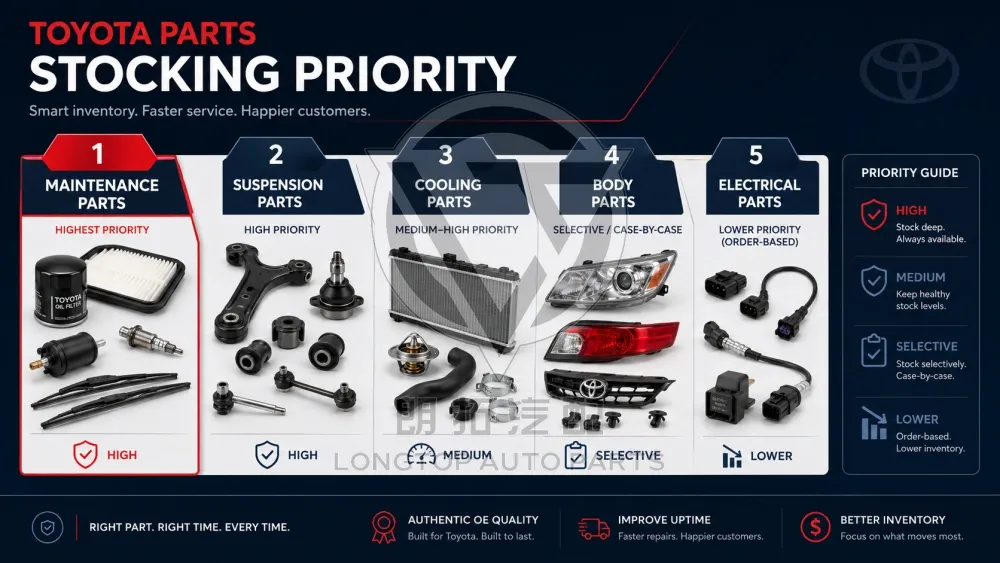
Not every Toyota part deserves warehouse stock. Fast-moving, repeatable, and lower-risk categories are better for stock, while expensive or model-sensitive parts should usually be handled by order.
For a deeper supplier-channel comparison, you can also read the Toyota Parts Supplier Types and Evaluation Guide.
Parts Usually Better for Stocking
Parts with stable replacement demand, broader model coverage, and manageable unit cost are usually better for stock planning. These may include filters, brake pads, brake discs, suspension bushings, control arms, stabilizer links, common lamps, mirrors, clips, brackets, and small body parts.
In hot-climate markets, cooling-related parts may also deserve more attention. In SUV and pickup markets, suspension and chassis wear parts may turn faster than some general passenger-car parts.
The key is not only whether the part is popular. The better question is whether it can create repeat orders without creating too much wrong-part or dead-stock risk.
Parts Better for Order-Based Sourcing
Some Toyota and Lexus parts look profitable but are risky to hold in stock. ECU-related parts, ABS components, engine internal parts, transmission-related parts, high-value body assemblies, rare Lexus parts, and low-volume model-specific parts should usually be handled by order.
These categories often require more careful confirmation because the cost of a wrong purchase is higher. If the part does not move quickly, the gross margin on paper may not become real profit.
A Practical Stocking Method
Start with a controlled test list instead of trying to cover every Toyota model. For example, build a 20–50 SKU trial list, then divide it into fast-moving, medium-moving, and order-based groups.
Review inquiry frequency, sales conversion, return rate, and replenishment speed every month. After you know which categories actually move in your market, expand the stock list gradually.
How Should You Judge MOQ, Lead Time, and Mixed Order Feasibility?
MOQ and lead time are not fixed supplier promises. They change with product category, stock status, order mix, packing requirement, and how many sourcing channels are involved.
MOQ Depends on Part Type
Fast-moving small parts usually have more flexible MOQ because suppliers or stock channels handle them more often. Bulky body parts may be limited by volume, packing cost, and shipping space. Genuine Toyota parts may allow smaller quantities when stock is available, but price and availability can change quickly.
Factory-direct aftermarket parts may offer better unit price, but MOQ can be higher. Stock-based sourcing or trading channels may be more flexible for mixed Toyota parts orders, especially when the buyer needs many OE numbers in one shipment.
Lead Time Depends on Stock and Consolidation
A single in-stock item may move quickly. A mixed SKU order may take longer because different products need to be checked, collected, packed, and coordinated.
This does not automatically mean mixed orders are inefficient. For wholesalers, repair chains, and fleet buyers, extra consolidation time can reduce repeated communication, separate freight, missing items, and supplier-management cost.
When Mixed Orders Make Sense
Mixed orders make sense when you are sourcing across several Toyota or Lexus systems: maintenance parts, suspension parts, body parts, cooling parts, and selected electrical parts.
They are less suitable when the purchase goal is only short-term price comparison, one single low-value item, or a product photo without clear part information.
MOQ / lead time table
| Part Type | Stocking Logic | MOQ Factor | Lead Time Risk |
|---|---|---|---|
| Maintenance parts | Stock | Usually flexible | Low |
| Suspension parts | Stock + order | Medium | Medium |
| Electrical parts | Order-based | OE dependent | Higher |
| Body parts | Case by case | Volume-sensitive | Medium |
| Rare Lexus parts | Order-based | Stock-dependent | Higher |
What Supplier Type Fits Your Toyota Parts Business Model?
There is no universal best Toyota parts supplier. The right supplier type depends on whether your priority is price, SKU coverage, technical review, genuine parts access, mixed order support, or fast local delivery.
Local Distributor or Dealer Channel
Local distributors are useful for urgent repair demand, small orders, and immediate after-sales communication. If your customer needs the part today, local supply can be more practical than international sourcing.
The trade-off is usually higher cost, limited SKU coverage, and less flexibility for long-term wholesale margin planning.
Factory or Manufacturer
Factories are suitable for single-category, high-volume aftermarket parts. This can work well when you need stable production, private label packaging, or price-sensitive replacement parts.
The limitation is coverage. A factory may be strong in one product category but weak for complex Toyota/Lexus mixed lists, genuine parts sourcing, or multi-category order coordination.
Trading or Sourcing Company
A trading or sourcing company can be useful when you need mixed SKU sourcing, channel comparison, stock checking, and order coordination. This is often practical when your purchase list includes many Toyota and Lexus parts across different systems.
The main point is to judge whether the supplier has real sourcing depth, not just a product catalog. Response quality, stock checking ability, replacement number comparison, packing support, and export experience matter more than a simple “we can supply” answer.
Online B2B Platform Supplier
Online B2B platforms are useful for supplier discovery and price comparison. They can help you understand available product types and approximate price ranges.
But platform listings do not always prove real stock, export experience, packaging quality, or technical matching ability. Treat them as a starting point, not the final sourcing decision.
Before building a Toyota parts stock list, it is useful to review Toyota’s official global sales, production, and export results, then compare that direction with your own local repair demand and customer inquiries.
What Makes Toyota Parts Sourcing Different by Market?
A Toyota parts sourcing guide cannot use one global template. You should adjust sourcing strategy by vehicle mix, climate, repair habits, logistics route, and payment conditions in each market.

Middle East Markets
For the UAE, Dubai’s re-export role and wholesale trading environment make SKU coverage, price structure, and redistribution efficiency especially important. For more local detail, link this section to the UAE Toyota Parts Market and Dubai Re-export Guide.
For Saudi Arabia, sourcing decisions should consider Land Cruiser, Hilux, and Camry-related demand, hot climate, and fleet repair needs. Cooling parts, suspension parts, filters, body parts, and SUV/pickup wear parts deserve closer attention. This section should link to the Saudi Arabia Toyota Parts Market Guide.
For Iraq, heat, dust, SUV and pickup demand, and shipment stability matter. It is safer to test fast-moving and practical repair categories before expanding into slow-moving high-value items. This section should link to the Iraq Toyota Parts Market Guide.
Central Asia and Russian-Speaking Markets
Kazakhstan has a Central Asia transit role, Russian-speaking buyer base, and land or rail route considerations. Mixed durable categories may be more practical than random high-value parts. This section should link to the Kazakhstan Toyota Parts Sourcing Guide.
Uzbekistan buyers should consider transport route, payment cost, communication efficiency, and consolidation cost. Smaller mixed orders may be more practical before scaling. This section should link to the Uzbekistan Toyota Parts Sourcing Guide.
For Russia-related sourcing, payment, logistics, customs, and compliance risk must be checked carefully before shipment. Buyers should not rely on assumptions or informal solutions. This section should link to Russia Toyota Parts Sourcing and Compliance Notes.
Southeast Asia Markets
Southeast Asian demand depends heavily on local Toyota model penetration, price sensitivity, tax, customs cost, and repair habits. In many cases, fast-moving maintenance and wear parts are easier to test than expensive slow-moving parts.
Market factor table
| Market | Buyer Focus | Product Direction | Main Risk |
|---|---|---|---|
| UAE | Re-export, wholesale | Mixed Toyota parts | Price competition |
| Saudi Arabia | SUV, fleet repair | Cooling, suspension, body | Heat and high usage |
| Kazakhstan | Transit, Russian-speaking buyers | Mixed durable parts | Route and payment |
| Iraq | SUV/pickup repair | Filters, cooling, chassis | Shipment stability |
| Uzbekistan | Central Asia sourcing | Fast movers + order-based parts | Communication/payment cost |
| Russia | Existing vehicle repair | Careful sourcing only | Compliance/payment/logistics |
How Should You Think About Profit and Turnover?
Profit is not only the difference between buying price and selling price. Real margin depends on turnover speed, wrong-part rate, freight allocation, return cost, and inventory pressure.
Fast Turnover Can Beat High Unit Margin
Regular wear parts may not have the highest unit margin, but they can create more stable turnover. High-value parts may look attractive, but one wrong purchase or slow-moving item can reduce the real margin quickly.
A practical Toyota parts business should not treat every SKU the same. Fast-moving parts, medium-moving parts, and inquiry-based parts should have different sourcing and stocking rules.
Freight and Packaging Change the Final Cost
Small parts are easier to consolidate and can help distribute freight cost across the order. Bulky body parts, lamps, and fragile components may require extra packaging and larger shipping volume.
Packaging damage is a hidden cost. It can lead to complaints, discounts, returns, and damaged customer trust.
Wrong-Part Risk Is a Margin Killer
Wrong parts create more than return cost. They affect customer confidence, workshop downtime, second shipment cost, and inventory accuracy.
For high-risk categories, start with smaller test orders, review actual customer demand, and scale only after product accuracy and turnover are proven.
When Does China Sourcing Become a Practical Option?
China sourcing becomes practical when your purchase list needs broader SKU access, mixed-category coordination, and flexible shipment planning. It should appear after you understand your market, product category, and order structure — not before.
China Can Support Mixed Toyota and Lexus Parts Lists
Toyota and Lexus sourcing is rarely a one-item job. A real purchase list may include maintenance parts, suspension parts, cooling parts, body parts, electrical parts, and model-specific parts in one order.
China-based sourcing can be useful when you need to compare different supply channels and consolidate many SKUs into one shipment.
The Value Is Not Only Lower Unit Price
A lower unit price is helpful, but it is not the whole decision. The larger value often comes from stock checking, replacement number comparison, mixed-order coordination, packing support, and shipment planning.
If these steps are handled poorly, a cheap quote can become expensive after wrong parts, delays, missing items, or damaged packaging.
China Sourcing Is Not Always the Right Answer
For urgent single-piece repair, local supply may still be better. For single-category, high-volume aftermarket production, a direct factory may be more suitable. For mixed Toyota/Lexus procurement, a sourcing partner may be more practical.
If your purchase list already includes Toyota and Lexus parts across several systems, you can use Toyota and Lexus Parts Sourcing Support to check whether mixed SKU sourcing is more practical than separate supplier purchasing.
How Can Longtop Support Toyota Parts Sourcing from China?
For buyers who already know their market direction and need China-based Toyota/Lexus sourcing support, Longtop can help review the order before shipment decisions are made.
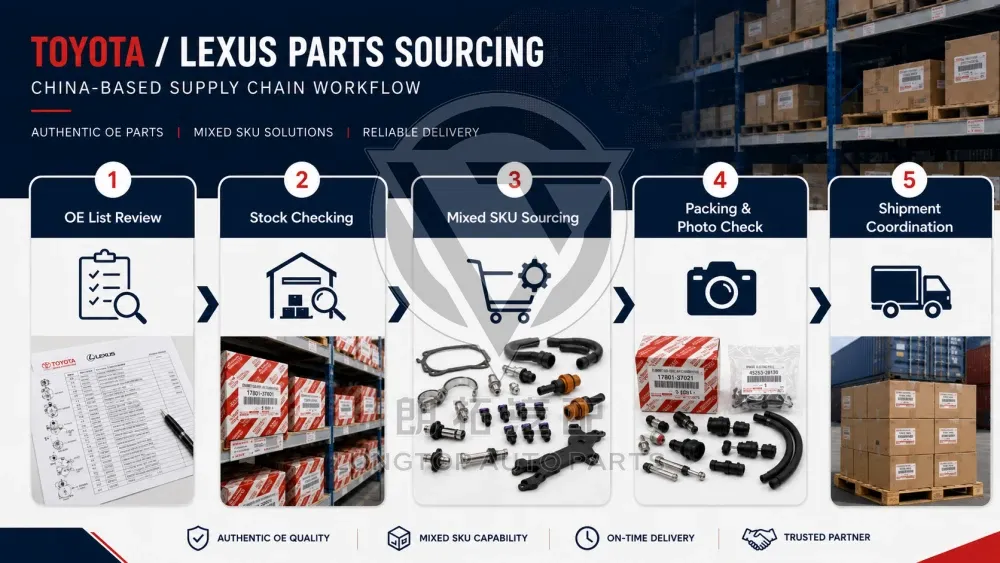
OE List Review and Stock Checking
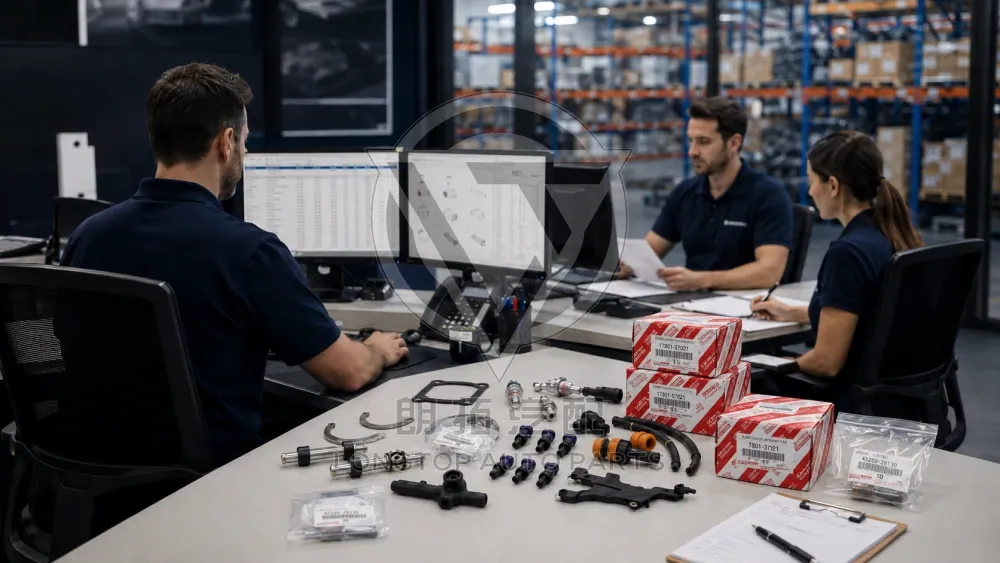
Longtop can help review your OE list, check available stock, compare replacement numbers, and identify items that need extra confirmation before purchase.
This is useful when one order includes many Toyota and Lexus SKUs across different product systems.
Mixed Toyota/Lexus Parts Orders
For wholesalers, distributors, repair-chain buyers, and fleet buyers, Longtop can support mixed SKU orders instead of forcing you to contact many separate suppliers.
The goal is not to claim every product is always the cheapest. The goal is to help you reduce mixed-order risk, wrong-part risk, packaging risk, and overstock pressure.
Shipment Coordination and Pre-Shipment Confirmation
Longtop can support packing suggestions, pre-shipment photo confirmation, and shipment coordination. This helps buyers make a more controlled sourcing decision before goods leave China.
Buyers with a ready OE list, model list, or mixed procurement plan can contact Longtop through the Toyota and Lexus Parts Inquiry page for stock checking and order review.
What Is a Practical Toyota Parts Sourcing Process?
A practical sourcing process starts from market demand, not random supplier search. First define models, product categories, order type, and risk level before asking for price.
Step 1 — Define Your Target Market and Models
Clarify the target country, Toyota/Lexus models, common repair demand, buyer type, and whether the order is for stock or customer-specific sourcing.
Step 2 — Prepare the Parts List
Prepare OE numbers, product names, estimated quantity, acceptable sourcing channel, and packaging or brand requirements.
Step 3 — Compare Supplier Capability
Evaluate SKU coverage, stock response speed, technical matching support, mixed order handling, and export shipment experience.
Step 4 — Test Before Scaling
Start with a smaller mixed order, check product accuracy, evaluate packaging, monitor customer return rate, and then expand fast-moving SKUs.
Suitable data module: Sourcing flowchart
Market demand → Model list → Parts list → Supplier capability check → Stock/MOQ/lead time review → Trial order → Bulk sourcing plan
FAQ
What is the best way to start a Toyota parts sourcing business?
Start from your local vehicle demand and customer type. Identify common Toyota/Lexus models, decide which categories move repeatedly, and build a small test list before expanding into broader stock.
Which Toyota parts are better for wholesale stock?
Maintenance parts, suspension wear parts, common body parts, cooling-related parts, and selected electrical small parts are usually better for stock planning. Rare Lexus parts, ECU-related parts, ABS-related parts, and high-value assemblies are often safer as order-based items.
Is China always the best source for Toyota parts?
Not always. China sourcing is more practical when you need mixed SKU support, broader category access, stock checking, and shipment coordination. For urgent local repair demand, a local distributor may still be faster.
How can I reduce wrong-part risk before placing an order?
Prepare a clear parts list with OE numbers, product names, quantities, target models, and acceptable sourcing channels. For mixed orders, ask the supplier to check stock, replacement numbers, and product photos before shipment.
What should I check before placing a bulk Toyota parts order?
Check market demand, product category, MOQ, lead time, packaging method, freight cost, payment terms, supplier capability, and local import requirements. For sensitive routes or markets, review compliance and payment risk before shipment.

The LongTopAuto team writes from 25+ years of genuine Toyota and Lexus OEM parts export experience in Guangzhou, China. Our guides come from daily OE number checks, packaging review, and export sourcing work.