

Hi, I’m Tatum, Auto Parts PM at Longtop Auto.
I spend most of my day helping overseas buyers check Toyota and Lexus parts before they order. Some buyers send a clean OE number. Some send a VIN. Some send a photo of an old part. Some only say, “I need parts for Land Cruiser 2020” or “Lexus RX front parts.”
That is normal. But here is the problem: Toyota Lexus parts buying guide work is not just about finding a part name or a price. For importers, the real job is to build a system that reduces wrong orders before money, shipping time, and customer trust are lost.
This guide will help you understand how to buy Toyota and Lexus parts more safely as an importer. We will cover OE number matching, VIN and chassis confirmation, model-year differences, regional vehicle versions, common parts categories, and the information you should prepare before asking for a quotation.
Why Do Importers Need a Toyota Lexus Parts Buying Guide?
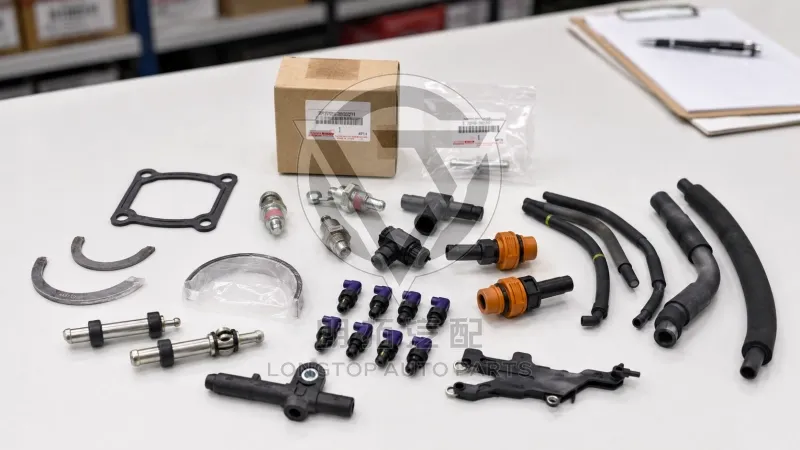
Importers need a Toyota Lexus parts buying guide because Toyota and Lexus vehicles are not always the same across markets, years, engines, trims, and body versions.
A Toyota Hilux in the Middle East may not use the same parts as a Hilux in Southeast Asia. A Land Cruiser Prado before facelift may not share the same bumper, grille, or lamps as the facelift version. A Lexus RX with one trim package may use different lamps, sensors, mirrors, or electronic parts from another RX that looks almost the same from outside.
This is why “model name + year” is often not enough.
A professional Toyota and Lexus parts inquiry should answer three basic questions:
| Buyer Question | Why It Matters |
|---|---|
| What exact part is needed? | Avoids confusing similar part names or related parts |
| Which vehicle version is it for? | Confirms year, chassis, engine, market, and trim |
| What evidence can confirm fitment? | Helps check OE number, VIN, chassis, photos, side, and function |
Toyota’s own parts resources also guide users to search by vehicle model or category, and Toyota’s official online parts store focuses on parts and accessories that fit Toyota vehicles. That shows the same principle buyers should follow: do not treat part names alone as final confirmation.
For the full Toyota and Lexus category hub, you can start from: Toyota Lexus Parts
What Should Importers Understand Before Buying Toyota and Lexus Parts?
Importers should understand five things before buying Toyota and Lexus parts: OE numbers, VIN or chassis numbers, model-year differences, regional versions, and part category risk.
If you understand these five areas, your quotation process becomes cleaner and your wrong-order risk becomes much lower.
| Area | What It Means | Buyer Risk If Ignored |
|---|---|---|
| OE number | Original part reference number | Similar parts may be quoted incorrectly |
| VIN / chassis number | Vehicle identity and production data | Supplier may not confirm exact version |
| Model year | Sales year or production period | Facelift and production changes may be missed |
| Regional version | GCC, Europe, Japan, USA, etc. | Lamps, bumpers, sensors, and emissions parts may differ |
| Part category | Body, engine, electrical, suspension, cooling | Some categories need stricter confirmation |
This is the foundation. Once the buyer has this framework, individual topics such as OE lookup, VIN checking, body parts selection, and model-specific buying become much easier.
For a deeper OE number guide, use: How to Check Toyota OE Part Numbers
Is the OE Number Enough for Toyota and Lexus Parts?
The OE number is usually the best starting point, but it is not always enough by itself.
If the OE number is correct, complete, and belongs to the exact vehicle version, it can often support accurate quotation. But in real import work, OE numbers may come from old invoices, marketplace listings, used parts, third-party catalogs, or customer screenshots. That means the number may be incomplete, replaced, or linked to a similar but different part.
Here is how I usually explain it to buyers:
| Part Type | Is OE Number Usually Enough? | Extra Confirmation Needed |
|---|---|---|
| Oil filter / air filter / cabin filter | Often yes | Engine and year for bulk orders |
| Brake pads / brake discs | Often yes | Chassis, market version, production year |
| Suspension arms / links | Often yes | Left or right side, 2WD or 4WD |
| Sensors | Sometimes | Plug shape, engine code, VIN |
| Headlamps / tail lamps | Not always | Side, LED or halogen, market version |
| Bumpers / grilles / exterior trim | Not always | Facelift, holes, mounting points, photos |
| Lexus electronic parts | Usually need more checking | VIN or chassis number strongly recommended |
ToyotaPartsDeal is an example of a public Toyota parts catalog that allows buyers to search Toyota genuine parts and accessories online, which can be useful as a reference when checking part names or catalog structure. But for import orders, especially bulk or mixed-category orders, buyers should still confirm fitment with complete vehicle information before purchasing.
For parts that should not be ordered without OE confirmation, use: Toyota Parts That Require OE Number Confirmation
When Should Importers Provide VIN or Chassis Number?
Importers should provide VIN or chassis number when the part is expensive, version-sensitive, electrical, body-related, or linked to Lexus trim options.
VIN or chassis number helps confirm the vehicle version when the model name is not enough. This is very common for Toyota SUVs, pickups, and Lexus models.
You should provide VIN or chassis number for:
- Headlamps and tail lamps
- Front bumper, rear bumper, grille, fender, hood, and exterior trim
- Mirrors with camera, heater, signal, or folding function
- Sensors, ABS parts, airbag-related parts, and ECU-related parts
- Cooling parts affected by engine or transmission version
- Lexus parts with trim, option, or electronic differences
- Any part where the buyer is not fully sure about the OE number
Lexus also has an official online parts catalog where users can select year, make, and model, review diagrams, and check parts information through dealer-based listings. This again shows why vehicle-level confirmation matters, especially for Lexus parts.
Which Toyota and Lexus Part Categories Should Importers Know First?
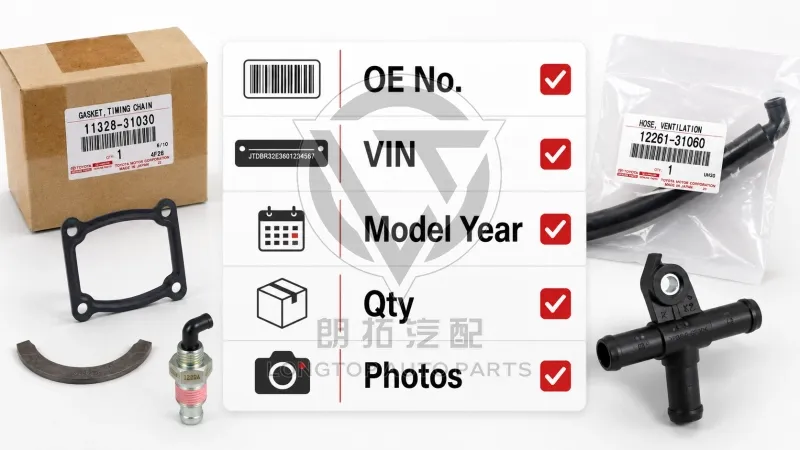
Importers should first understand the main Toyota and Lexus part categories because each category has different confirmation rules.
A buyer does not need to become a mechanic, but they should know which information matters for each category. That makes communication with suppliers much faster.
| Category | Common Items | Main Fitment Risk |
|---|---|---|
| Body parts | Bumper, grille, fender, hood, mirror cover | Facelift, holes, clips, side, finish |
| Lighting parts | Headlamp, tail lamp, fog lamp | LED/halogen, side, market version |
| Engine parts | Filters, pumps, belts, sensors | Engine code, production year, OE number |
| Cooling parts | Radiator, condenser, fan, water pump | Engine, transmission, market version |
| Suspension parts | Control arm, shock absorber, link, bushing | 2WD/4WD, left/right side, chassis |
| Brake parts | Pads, discs, calipers, sensors | Size, chassis, market version |
| Electrical parts | Sensors, switches, modules | Plug, pin count, system version |
| Lexus-specific parts | Lamps, mirrors, trim, electronics | Trim level, option package, VIN |
This is why I usually ask buyers to separate inquiries by category. A body part inquiry needs photos and facelift details. An engine part inquiry needs engine code. A lamp inquiry needs side and function. A Lexus electronic inquiry often needs VIN.
For model-specific examples, use:
- Toyota Land Cruiser Spare Parts Guide
- Toyota Hilux Spare Parts Buying Guide
- Lexus Parts Buying Guide
What Information Should Buyers Send Before Asking for a Quotation?
Buyers should send OE number, vehicle model, year, VIN or chassis number, engine code, side, quantity, and clear photos before asking for a Toyota or Lexus parts quotation.
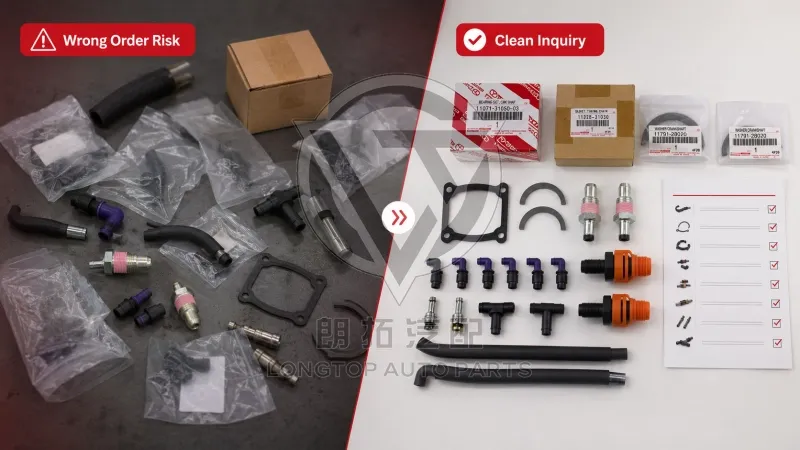
A clean inquiry helps the supplier quote faster. More importantly, it gives the supplier a chance to stop a wrong order before it happens.
Toyota Lexus Parts Quotation Checklist
Before sending your inquiry, prepare:
- OE number, if available
- Toyota or Lexus model name
- Model year or production year
- VIN or chassis number
- Engine code, if the part is engine-related
- Left side or right side, if applicable
- Quantity needed
- Market version, such as GCC, Europe, Japan, USA, or others
- Clear photos of the old part, label, connector, and mounting points
- Function details, such as LED, halogen, camera, heater, sensor holes, or folding mirror
For mixed orders, use one row for each part. Do not send one long message with many photos and no labels.
A better inquiry format looks like this:
| Item | OE Number | Vehicle | Year | Qty | Notes |
|---|---|---|---|---|---|
| Front lower arm RH | 48068-XXXXX | Toyota Prado | 2018 | 10 | GCC version |
| Headlamp LH | 81150-XXXXX | Lexus RX | 2020 | 2 | LED type, photo attached |
| Rear bumper cover | Unknown | Toyota Land Cruiser | 2021 | 5 | VIN provided, sensor holes needed |
This format is simple, but it reduces a lot of confusion.
How Should Importers Choose a Toyota and Lexus Parts Supplier?
Importers should choose a Toyota and Lexus parts supplier by fitment support, OE matching ability, category coverage, response quality, and wrong-order prevention, not only by price.
A low price does not help if the part does not fit. In many cases, the cost of a wrong order is much higher than the price difference between suppliers.
A reliable supplier should be able to:
- Check OE numbers before quotation
- Ask for VIN or chassis number when needed
- Identify facelift and model-year risks
- Confirm left/right side clearly
- Understand Toyota and Lexus model differences
- Handle mixed OE lists without losing item matching
- Check photos, labels, plugs, and mounting points
- Explain when model name alone is not enough
This is also where Longtop Auto can help. On longtopauto.com, our Toyota and Lexus parts work is built around OE number checking, VIN/chassis confirmation, model-version review, and category-based quotation support. For importers, distributors, repair shops, and fleet buyers, that means the conversation does not stop at “send price.” It starts with “let’s confirm the correct part first.”
You can review the Toyota and Lexus parts category here: Toyota Lexus Parts Supplier Support
Common Toyota Lexus Parts Buying Mistakes Importers Should Avoid
Most Toyota and Lexus parts buying mistakes happen because the inquiry looks clear on the surface but misses one fitment detail.
Here are the mistakes I see most often:
- Ordering by model name only
“Toyota Camry 2019” or “Lexus RX 2020” is not enough for many lamps, body parts, sensors, or electronic parts. - Ignoring facelift differences
Bumpers, grilles, headlamps, tail lamps, and trim parts may change before and after facelift. - Not confirming left and right side
Always define LH and RH from the driver sitting inside the vehicle unless another standard is agreed. - Using photos as the only confirmation
Photos help, but they may not show plug pins, brackets, clips, sensor holes, or inner mounting points. - Forgetting regional versions
GCC, Japan, Europe, USA, and other market versions can have different lamps, bumpers, mirrors, and emissions-related parts. - Treating Lexus parts like simple Toyota parts
Lexus parts often need stricter confirmation because trim level, option package, and electronic function can affect fitment. - Sending mixed photos without item labels
If the supplier cannot match each photo to each part number, quotation risk increases.
FAQ
What is the best way for importers to buy Toyota and Lexus parts?
The best way is to start with OE number, then confirm VIN or chassis number for version-sensitive parts. For body parts, lamps, electrical parts, and Lexus parts, buyers should also send photos, side, model year, and market version.
Can I buy Toyota parts only by OE number?
Yes, many Toyota parts can be quoted by OE number. But for lamps, bumpers, sensors, electrical parts, and Lexus components, OE number should be checked with VIN, chassis, or vehicle details before order confirmation.
Why is VIN or chassis number important for Toyota Lexus parts?
VIN or chassis number helps confirm the exact vehicle version. It can reduce mistakes caused by model-year differences, regional versions, facelift changes, engine differences, and trim options.
Are Toyota and Lexus parts interchangeable?
Some Toyota and Lexus models may share certain components, but buyers should not assume interchangeability. OE number, VIN/chassis number, engine code, side, and vehicle version should be checked before ordering.
What should I send for a fast Toyota or Lexus parts quotation?
Send OE number, vehicle model, year, VIN or chassis number, engine code, side, quantity, market version, and clear photos. For mixed orders, list each part in a separate row.
Conclusion
A practical Toyota Lexus parts buying guide should help importers build one habit: confirm the correct part before asking only for the lowest price.
Toyota and Lexus parts purchasing is a system. OE number matching, VIN/chassis confirmation, model-year checking, regional version review, category knowledge, and clear inquiry format all work together.
When buyers prepare this information well, suppliers can quote faster, fitment risk becomes lower, and bulk orders become easier to manage. For importers, distributors, repair shops, body shops, and fleet buyers, that is how Toyota and Lexus parts buying becomes more stable and less costly.

Auto parts insights from the Longtop team, focused on sourcing, quality, and practical product knowledge.